
The Happy Hollisters and the Mystery of the Totem Faces
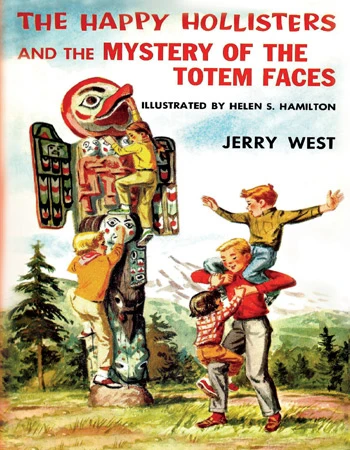
An Adventure Back to 1958
There was a time when a good mystery didn't begin with a glowing screen. It began with a book.
For me, it was going to Stone Memorial Library in Conneautville, PA. Maybe it came home from the Scholastic Book Fairs, or perhaps it was waiting under the Christmas tree with your name written inside the cover.
Then you found your favorite chair, stretched out across the living-room rug, or crawled into bed with a flashlight and started reading. Before long, you weren't home anymore. You were off on an adventure.
For generations of young readers, The Happy Hollisters could do exactly that.
And in 1958, The Happy Hollisters and the Mystery of the Totem Faces took readers farther from home than usual—all the way to Alaska.

Remember When a Book Could Take You Anywhere?
The 1950s and early 1960s were a different time to be a kid. There were bicycles leaning against trees out front, Saturday morning cartoons, baseball gloves that stayed in use for years, neighborhood stores where the owner knew your family, and evenings when entertainment might mean a board game around the kitchen table.
And there were books. Children didn't need flashing graphics or an internet connection to discover another world. All they needed was a story good enough to make their imagination take over.
The Happy Hollisters were especially good at that.
Pete, Pam, Ricky, Holly, and Sue Hollister were ordinary children who had a remarkable habit of stumbling into mysteries. Their adventures mixed family, travel, history, geography, new cultures, clues, villains, and just enough danger to keep young readers turning pages.
The Happy Hollisters and the Mystery of the Totem Faces was the fifteenth adventure in the series.
This time, the mystery begins with an old gold miner, a mysterious totem pole, and a secret that has been waiting for years to be discovered.
The Mystery of the Totem Faces
The adventure begins when the Hollister children meet an elderly man who had once been a gold miner in Alaska. He has brought home a small totem pole as a souvenir of his adventurous days in the Far North. But there is something particularly interesting about it. The old miner tells the children that his souvenir is a replica of another totem pole—one that had been lost somewhere near Sitka, Alaska.
And that missing totem pole supposedly holds a secret. That's more than enough to capture the Hollister children's attention.
At about the same time, their Uncle Russ is facing a problem of his own. Uncle Russ is a commercial artist and cartoonist, and he needs fresh ideas and a new setting for his comic-strip characters.

The Hollister children have a suggestion:
Soon the family is headed north with Uncle Russ and the children's cousins, Teddy and Jean.
What begins as inspiration for a cartoon quickly becomes a real-life mystery.
The Hollisters begin searching for information about the missing totem pole while exploring a place very different from their hometown. Along the way, they encounter the traditions, scenery, people, and ways of life of Alaska while following the clues left behind from the old miner's story.
But the Hollisters aren't the only people interested in what the missing pole may reveal. A sinister thief is after the secret, too. That turns the children's search into a race.
Clue by clue, the mystery leads them closer to the missing totem pole. Eventually, the Hollisters locate it—and discover something hidden inside.
Now the mystery of the strange faces carved into the pole becomes something much bigger.
The Hollisters must use their curiosity, teamwork, courage, and detective skills to follow the trail while staying ahead of the thief who wants the treasure for himself.
It is classic Happy Hollisters: a family adventure, an intriguing mystery, a faraway destination, a little danger, and plenty to learn along the way.
A Children's Mystery That Quietly Taught You Something
That was part of the magic of books like the Happy Hollisters. You thought you were simply solving a mystery. Meanwhile, you were learning.
The stories introduced children to unfamiliar places, customs, history, geography, occupations, and traditions without making the experience feel like a school lesson.
In The Mystery of the Totem Faces, Alaska wasn't simply a backdrop for the adventure. The journey gave young readers in 1958 a glimpse of a part of America that many of them could only imagine visiting.
Remember what that meant in those days.
There was no Google Maps. No YouTube travel video. No smartphone where you could type "Sitka, Alaska" and instantly see hundreds of photographs.
For a child sitting in Pennsylvania, North Carolina, Ohio, Iowa, or anywhere else across America, a book could be the first doorway into a place thousands of miles away.
You turned the page—and suddenly you were there.
The World of the Happy Hollisters
The Happy Hollisters books themselves belong to another interesting piece of American publishing history.
The name Jerry West appeared on the books, but Jerry West was actually the pen name of author Andrew E. Svenson. Svenson wrote the Happy Hollisters adventures and drew inspiration in part from his own family, travels, newspaper clippings, and conversations with children and teachers.
The Hollisters weren't superheroes. They didn't have magical powers. They were a family.
They asked questions. They noticed things. They followed clues. They helped one another. They got excited about discovering someplace new.
Perhaps that is one reason the stories still feel comforting decades later.
They remind us of childhood adventures when the world seemed enormous and mysterious—and discovering what was around the next corner was half the fun.
Do You Remember Reading Like This?
Maybe you remember bringing home a stack of books from the library. Maybe there was a Happy Hollister book among them.
There was something wonderful about being completely absorbed in a story.
No notifications. No scrolling. No charging cable. Just a book, your imagination, and an afternoon that somehow disappeared.
This Story Feels at Home at Harvest Array
You may be wondering what a children's mystery published in 1958 has to do with Harvest Array.
Actually, quite a bit.
At Harvest Array, we spend a lot of time looking for things that remind us of what a traditional American general store once represented—useful products, simple pleasures, quality goods, family traditions, and discoveries you might not find everywhere else.
But a general store was about more than merchandise. It was part of a community.
It was a place where people exchanged stories, heard the latest news, discovered something new, and sometimes found something they didn't even know they were looking for.
That's part of what we hope to preserve online.
The Happy Hollisters remind us of another tradition worth keeping: giving children the chance to discover the joy of imagination.
Fresh Off the Blog—Like Jam Off the Stove

Honoring the Hands That Feed Us: Celebrating National Farmers Day, Today, 10.12.26
Every year on October 12, we celebrate National Farmers Day, a day dedicated to honoring the hard wo...

National Do Something Nice Day: Simple Acts of Kindness to Brighten Someone’s Day
What if one small act of kindness completely changed someone's day? From sharing a homemade treat a...

Celebrate National Family Day: Gather Around the Table, Make Memories, and Enjoy Good Food
We already know that we don't need a National Day to remind us how important our families are to us,...
Troyer's Rope Company
Manufacturers of solid braided multifilament polypropylene rope, it's the rope derby people love! "A...
The Happy Hollisters and the Mystery of the Totem Faces
An Adventure Back to 1958 There was a time when a good mystery didn't begin with a glowing screen. I...

Fall Flavors & Football: Easy Crock Pot and Tailgating Recipes for the Season
You can always tell when fall is coming.. mornings are a little more crisp than what we have been us...